• 5 min read
TOPICS: E-Commerce / E-Commerce Strategy / Digital Retail Strategy
The startup peels shoppers away from major retailers with a browser extension—and more than 19 million products.
Goodbuy
Shoppers have always liked a good value, but these days it’s values in another sense that are also turning heads. In a recent Harris Poll survey commissioned by Google Cloud, 82% of consumers say they want to buy from brands that share their values.
But desire and action are two different things, which is why, even though Earth Day is so popular, it takes plastic-bag bans to get many shoppers to start bringing tote bags to Target.
Now, a Boise-based startup, Goodbuy, is promising to make it easy to shop consciously online. Yes, consumers can find plenty of curated marketplaces tailored by criteria important to them, such as being Black-owned or eco-friendly—and retailers like Target also offer similar filters on their sites. Still, all of that may rely on shoppers being more focused than they typically are when ordering sriracha on Amazon while watching the Ozark finale.
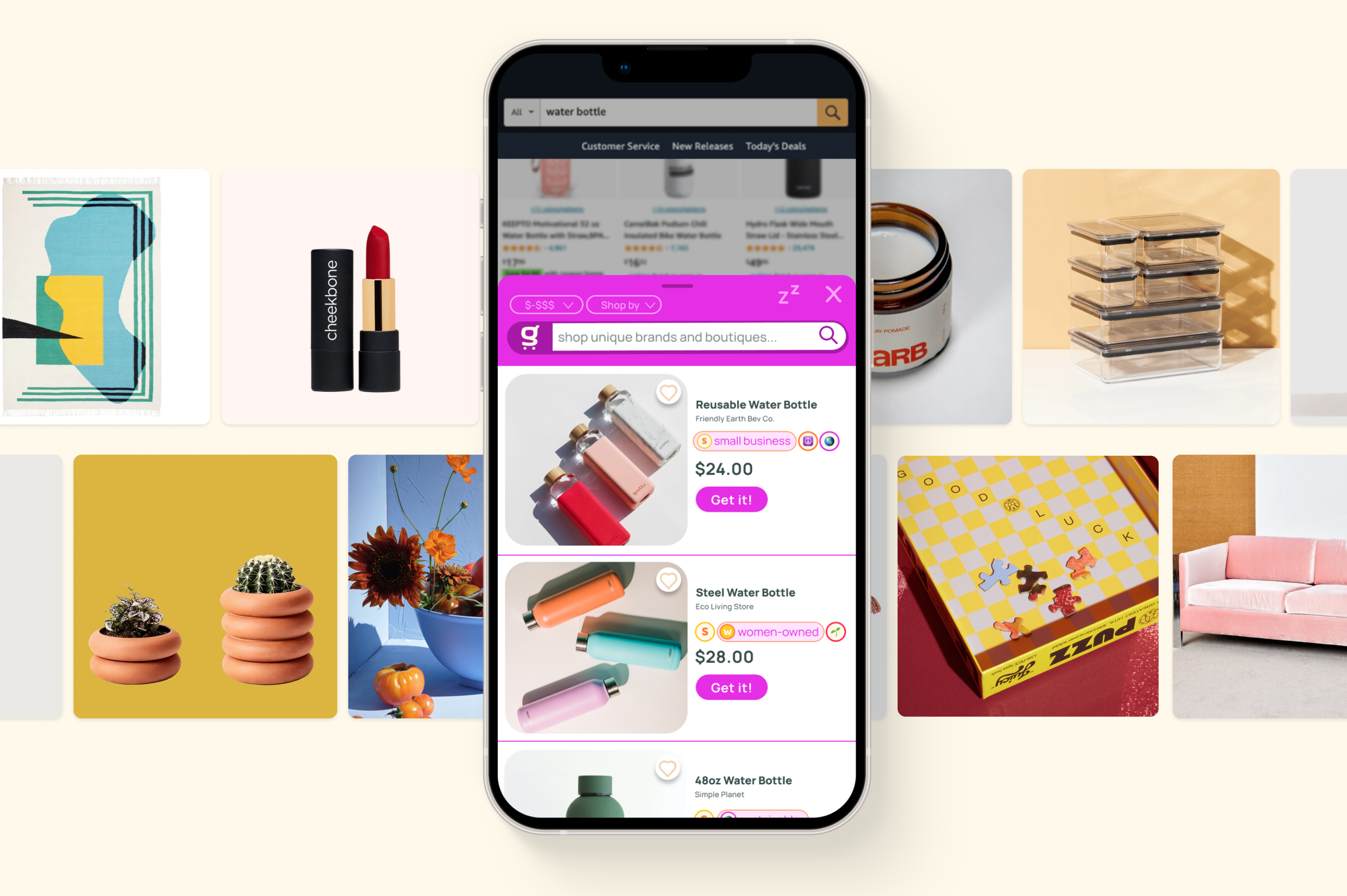
Goodbuy is different. For starters, its primary function is as a browser extension that kicks in when you’re shopping online, highlighting the same (or similar) products from businesses that may be smaller, more diverse, and socially conscious.
“The issue that we had up until this point was that it was inefficient and laborious to be a conscious shopper,” Cara Oppenheimer, who co-founded Goodbuy in 2021 with friend and fellow working mom Cary Fortin, told Retail Brew. “While on the other side, it’s hyper-efficient to be able to go to these mega-retailers and get the gratification you need, but it wasn’t fulfilling—it didn’t feel good.”
Like another browser extension, Capital One Shopping, which uses pop-up windows to alert shoppers browsing on sites like Amazon when other sites have cheaper prices, Goodbuy also relies on pop-ups that highlight other retailers.
As for how Goodbuy, which in addition to the founders has only eight employees, managed to aggregate ~185,000 small businesses, they are not tipping their hand; instead, the pair cited “proprietary data” and building “comprehensive back-end technology.”
Goodbuy debuted solely as a Chrome extension for laptops and desktops in late November, but this week it made its debut in the Apple app store, as a Safari extension. Oppenheimer described the first five months of operation solely on non-mobile devices as “a very narrow containment strategy” for the platform to build a customer base, but said it has been ramping up steadily.
“These numbers might feel small, but our potential is significant and even just a tiny, tiny, tiny sliver of this has a real impact on small business owners,” Oppenheimer said.
Small businesses can, of course, sell their wares on Amazon, under various fee scenarios that include per-item referral fees and may include monthly fees. Goodbuy’s revenue model, similarly, is to take a referral fee when an item sells, but Fortin noted that unlike with Amazon, the purchase is completed and fulfilled by the seller.
“So now they’ve got your email [and] your address,” Fortin said. “That is a relationship that we have facilitated for you, and as a small business, you now own that lead.”
Goodbuy plans to release extensions for the desktop versions of both Firefox and Safari by the end of 2022. And Fortin and Oppenheimer said that they are hoping to land a Series A fundraising round within a year, too.
They noted that, like many of the retail brands on Goodbuy, they are woman-owned. And while women founders raised just 2% of venture capital in the US in 2021—a five-year low, according to Pitchbook—but the pair are undaunted.
“We have been growing steadily, and we are starting to really accelerate as a company right now,” Fortin said. “So we are headed in a really powerful direction.”